


|
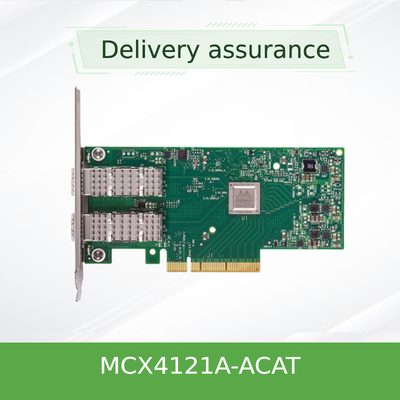
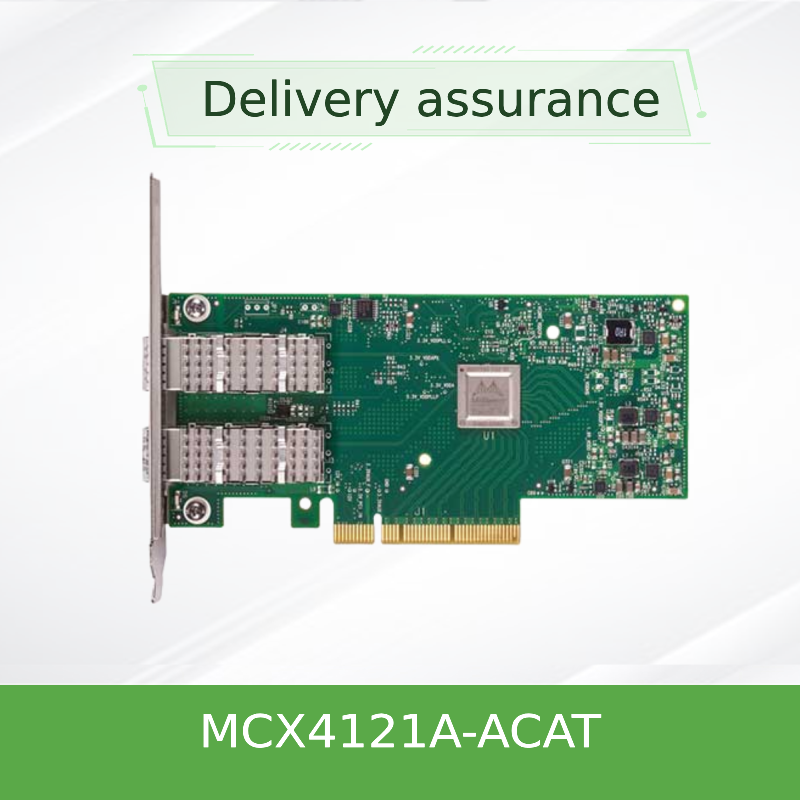
NVIDIA MCX4121A-ACAT ConnectX-4 Lx EN 25GbE Adapter for Cloud, Web 2.0, Storage & Analytics
Product Details:
| Brand Name: | Mellanox |
| Model Number: | MCX4121A-ACAT |
| Document: | connectx-4-lx-en-card.pdf |
Payment & Shipping Terms:
| Minimum Order Quantity: | 1pcs |
|---|---|
| Price: | Negotiate |
| Packaging Details: | outer box |
| Delivery Time: | Based on inventory |
| Payment Terms: | T/T |
| Supply Ability: | Supply by project/batch |
|
Detail Information |
|||
| Application: | Server | Interface Type:: | Network |
|---|---|---|---|
| Ports: | Dual | Max Speed: | 25GbE |
| Connector Type: | SFP28 | Type: | Wired |
| Condition: | New And Original | Model: | MCX4121A-ACAT |
| Name: | Mellanox Network Card ConnectX-4 Lx EN 25GbE Dual-Port SFP28 PCIe3.0 X8 Network Interface Card MCX4121A-ACAT | Keyword: | Mellanox Network Card |
| Highlight: | NVIDIA ConnectX-4 Lx 25GbE Adapter,ConnectX-4 Lx Network Card for Cloud,NVIDIA 25GbE Adapter for Storage Analytics |
||
Product Description
NVIDIA Networking | ConnectX-4 Lx EN Ethernet Adapter Card
The NVIDIA ConnectX-4 Lx EN adapter card family addresses virtualized infrastructure challenges for today's demanding markets and applications. Providing true hardware-based I/O isolation with unmatched scalability and efficiency, ConnectX-4 Lx EN offers a cost-effective and flexible Ethernet adapter solution for Web 2.0, cloud, data analytics, database, and storage platforms.
The MCX4121A-ACAT is the dual-port 25GbE SFP28 member of the ConnectX-4 Lx EN family, with a PCIe Gen 3.0 x8 host interface and UEFI support. It supports Ethernet speeds of 25, 10, and 1 GbE. The ConnectX-4 Lx EN family provides a combination of 1, 10, 25, 40, and 50 GbE bandwidth, sub-microsecond latency, and a 75 million packets per second message rate.
ConnectX-4 Lx EN includes native hardware support for RDMA over Converged Ethernet (RoCE), Ethernet stateless offload engines, overlay networks, GPUDirect technology, and Mellanox Multi-Host technology. With the exponential increase in usage of data and the creation of new applications, ConnectX-4 Lx EN adapter cards enable data centers to increase operational efficiency, improve server utilization, maximize application productivity, and reduce total cost of ownership (TCO).
- Two 25GbE SFP28 ports (supports 25, 10, and 1 GbE)
- PCIe Gen 3.0 x8 host interface
- 1/10/25/40/50 Gb/s speeds across the ConnectX-4 Lx EN portfolio
- Single and dual-port options
- Virtualization support with SR-IOV
- Low latency RDMA over Converged Ethernet (RoCE)
- Mellanox Multi-Host technology connects up to 4 independent hosts
- CPU offloading of transport operations
- Application offloading
- Mellanox PeerDirect communication acceleration
- Hardware offloads for NVGRE, VXLAN, and GENEVE encapsulated traffic
- End-to-end QoS and congestion control
- Hardware-based I/O virtualization
- UEFI enabled (x86/Arm)
- RoHS compliant and ODCC compatible
- Various form factors available
Mellanox Multi-Host technology enables data centers to design and build scale-out heterogeneous compute and storage racks, with direct connectivity between compute elements and the network. It works by allowing multiple hosts to connect into a single interconnect adapter, by separating the adapter PCIe interface into several independent PCIe interfaces. Each interface connects to a separate host CPU with no performance degradation. By reducing the number of cables, NICs, and switch ports required by four independent servers from four to one of each, Mellanox Multi-Host reduces data center CAPEX and OPEX.
Additional benefits include remote control of configuration and power state per host, guaranteed host security and isolation, and a single BMC with independent NC-SI/MCTP management channels for each managed host. Mellanox Multi-Host also supports heterogeneous data center architectures, where connected hosts can be x86, Power, GPU, Arm, or FPGA.
ConnectX-4 Lx EN SR-IOV technology provides dedicated adapter resources and guaranteed isolation and protection for virtual machines (VMs) within the server. I/O virtualization with ConnectX-4 Lx EN gives data center administrators better server utilization while reducing cost, power, and cable complexity, allowing more virtual machines and more tenants on the same hardware.
Data center operators often create overlay networks that carry traffic from individual virtual machines over logical tunnels in encapsulated formats such as NVGRE and VXLAN. While this solves network scalability issues, it hides the TCP packet from the hardware offloading engines, placing higher loads on the host CPU. ConnectX-4 Lx EN addresses this by providing advanced NVGRE, VXLAN, and GENEVE hardware offloading engines that encapsulate and decapsulate the overlay protocol headers, enabling the traditional offloads to be performed on the encapsulated traffic for these and other tunneling protocols (GENEVE, MPLS, QinQ, and so on). With ConnectX-4 Lx EN, data center operators can achieve native performance in the new network architecture.
ConnectX-4 Lx EN supports RoCE specifications delivering low-latency and high-performance over Ethernet networks. Leveraging data center bridging (DCB) capabilities as well as ConnectX-4 Lx EN advanced congestion control hardware mechanisms, RoCE provides efficient low-latency RDMA services over Layer 2 and Layer 3 networks.
Mellanox PeerDirect communication provides high-efficiency RDMA access by eliminating unnecessary internal data copies between components on the PCIe bus (for example, from GPU to CPU), and therefore significantly reduces application run time. ConnectX-4 Lx EN advanced acceleration technology enables higher cluster efficiency and scalability to tens of thousands of nodes.
Storage applications will see improved performance with the higher bandwidth ConnectX-4 Lx EN delivers. Standard block and file access protocols can leverage RoCE for high-performance storage access. A consolidated compute and storage network achieves significant cost-performance advantages over multi-fabric networks.
Mellanox host management and control capabilities include NC-SI over MCTP over SMBus, and MCTP over PCIe - Baseboard Management Controller (BMC) interface, as well as PLDM for Monitoring and Control DSP0248 and PLDM for Firmware Update DSP0267. All Mellanox adapter cards are supported by Windows, Linux distributions, VMware, FreeBSD, and Citrix XenServer. ConnectX-4 Lx EN supports various management interfaces and a rich set of tools for configuration and management across operating systems.
Additionally, ConnectX-4 Lx EN provides the option for a secure firmware update check using digital signatures to prevent remote attackers from uploading malicious firmware images; this ensures that only officially authentic images produced by Mellanox can be installed, regardless of whether the source of the installation is the host, the network, or a BMC.
- Web 2.0, cloud, and data analytics platforms requiring high bandwidth and low latency
- Database and storage platforms using RoCE for high-performance storage access
- Virtualized servers using SR-IOV for VM isolation and guaranteed QoS
- Overlay networks deploying NVGRE, VXLAN, or GENEVE encapsulation
- Scale-out heterogeneous compute and storage racks using Mellanox Multi-Host
- GPU-accelerated clusters using PeerDirect (GPUDirect) communication acceleration
- Servers requiring remote boot over Ethernet or iSCSI with PXE/UEFI support
The MCX4121A-ACAT uses standard SFP28 connectivity for 25, 10, and 1 GbE links. It is a PCIe Gen 3.0 x8 card and is compatible with PCIe Gen 3.0, 1.1, and 2.0 interfaces, with auto-negotiation to x8, x4, x2, or x1 lanes. It interoperates with 1/10/25/40/50 Gb/s Ethernet switches and supports passive copper cables with ESD protection and powered connectors for optical and active cable support.
Operating system support includes RHEL/CentOS, Windows, FreeBSD, VMware, OpenFabrics Enterprise Distribution (OFED), and OpenFabrics Windows Distribution (WinOF-2), plus Citrix XenServer. UEFI support is enabled for x86 and Arm servers. Because system-level compatibility can depend on server platform, firmware, and OS/driver versions, please confirm the exact host configuration before ordering.
| Parameter | Value |
|---|---|
| Max network speed | 2x 25GbE |
| Interface type | SFP28 |
| Supported Ethernet speeds | 25, 10, 1 GbE |
| Form factor | PCIe HHHL (half-height, half-length) stand-up card |
| Additional features | UEFI Enabled (x86/Arm) |
| Dimensions without bracket | 14.2cm x 6.9cm (low profile) |
| Parameter | Value |
|---|---|
| PCIe generation | PCIe Gen 3.0 x8 |
| PCIe compatibility | PCIe Gen 3.0 compliant, 1.1 and 2.0 compatible |
| Link rate | 2.5, 5.0, or 8.0 GT/s |
| Lane negotiation | Auto-negotiates to x8, x4, x2, or x1 lanes |
| Interrupt mechanisms | MSI / MSI-X |
| Feature | Status |
|---|---|
| 50GbE / 40GbE / 25GbE / 10GbE / 1GbE | Supported across the portfolio |
| IEEE 802.3bj, 802.3bm 100 Gigabit Ethernet | Supported |
| 25G Ethernet Consortium 25, 50 Gigabit Ethernet | Supported |
| IEEE 802.3ba 40 Gigabit Ethernet | Supported |
| IEEE 802.3ae 10 Gigabit Ethernet | Supported |
| IEEE 802.3az Energy Efficient Ethernet | Supported |
| IEEE 802.3ap based auto-negotiation and KR startup | Supported |
| Proprietary Ethernet protocols (20/40GBASE-R2, 50GBASE-R4) | Supported |
| IEEE 802.3ad, 802.1AX Link Aggregation | Supported |
| IEEE 802.1Q, 802.1P VLAN tags and priority | Supported |
| IEEE 802.1Qau (QCN) Congestion Notification | Supported |
| IEEE 802.1Qaz (ETS) | Supported |
| IEEE 802.1Qbb (PFC) | Supported |
| IEEE 802.1Qbg | Supported |
| IEEE 1588v2 | Supported |
| Jumbo frame support (9.6KB) | Supported |
| Feature | Status |
|---|---|
| Up to 4 separate PCIe interfaces to 4 independent hosts | Supported |
| Two PCIe x4 to two hosts, four PCIe x4 to four hosts, or four PCIe x2 to four hosts | Supported |
| Independent NC-SI SMBus interfaces | Supported |
| Independent stand-by and wake-on-LAN signals | Supported |
| Feature | Status |
|---|---|
| Hardware-based reliable transport | Supported |
| Collective operations offloads | Supported |
| Vector collective operations offloads | Supported |
| PeerDirect RDMA (GPUDirect communication acceleration) | Supported |
| 64/66 encoding | Supported |
| Extended Reliable Connected transport (XRC) | Supported |
| Dynamically Connected transport (DCT) | Supported |
| Enhanced Atomic operations | Supported |
| Advanced memory mapping support (UMR) | Supported |
| On-demand paging (ODP) | Supported |
| Registration-free RDMA memory access | Supported |
| Feature | Status |
|---|---|
| RDMA over Converged Ethernet (RoCE) | Supported |
| TCP/UDP/IP stateless offload | Supported |
| LSO, LRO, checksum offload | Supported |
| RSS (can be done on encapsulated packet), TSS, VLAN insertion/stripping, Receive flow steering | Supported |
| Intelligent interrupt coalescence | Supported |
| Feature | Status |
|---|---|
| Stateless offloads for overlay networks and tunneling protocols | Supported |
| Hardware offload of encapsulation and decapsulation of NVGRE and VXLAN overlay networks | Supported |
| Feature | Status |
|---|---|
| Single Root IOV | Supported |
| Multi-function per port | Supported |
| Address translation and protection | Supported |
| Multiple queues per virtual machine | Supported |
| Enhanced QoS for vNICs | Supported |
| VMware NetQueue support | Supported |
| Feature | Status |
|---|---|
| SR-IOV Virtual Functions | Up to 256 Virtual Functions |
| SR-IOV Physical Functions per port | Up to 8 Physical Functions per port |
| Virtualization hierarchies (e.g. NPAR) | Supported |
| Virtualizing Physical Functions on a physical port | Supported |
| SR-IOV on every Physical Function | Supported |
| Ingress and egress QoS levels | Supported |
| Guaranteed QoS for VMs | Supported |
| Protocol | Status |
|---|---|
| OpenMPI, IBM PE, OSU MPI (MVAPICH/2), Intel MPI | Supported |
| Platform MPI, UPC, Open SHMEM | Supported |
| TCP/UDP, MPLS, VxLAN, NVGRE, GENEVE | Supported |
| SER, NFS RDMA, SMB Direct | Supported |
| uDAPL | Supported |
| Feature | Status |
|---|---|
| NC-SI over MCTP over SMBus | Supported |
| NC-SI over MCTP over PCIe | Supported |
| Baseboard Management Controller interface | Supported |
| SDN management interface for managing the eSwitch | Supported |
| I²C interface for device control and configuration | Supported |
| General Purpose I/O pins | Supported |
| SPI interface to flash | Supported |
| JTAG IEEE 1149.1 and IEEE 1149.6 | Supported |
| Feature | Status |
|---|---|
| Remote boot over Ethernet | Supported |
| Remote boot over iSCSI | Supported |
| PXE and UEFI | Supported |
| Parameter | Value |
|---|---|
| Power consumption | Not publicly specified — please confirm before ordering |
| Operating temperature | Not publicly specified — please confirm before ordering |
| Regulatory compliance | RoHS compliant, ODCC compatible |
The ConnectX-4 Lx EN portfolio includes multiple form factors and port configurations. The table below summarizes the PCIe HHHL options described in the product brief. For OCP 2.0 and OCP 3.0 options, please contact your NVIDIA sales representative.
| Max Network Speed | Interface | Speeds (GbE) | Host Interface | OPN |
|---|---|---|---|---|
| 1x 10GbE | SFP28 | 10, 1 | PCIe 3.0 x8 | MCX4111A-XCAT |
| 2x 10GbE | SFP28 | 10, 1 | PCIe 3.0 x8 | MCX4121A-XCAT |
| 2x 10GbE | SFP28 | 10, 1 | PCIe 3.0 x8 | MCX4121A-XCHT |
| 1x 25GbE | SFP28 | 25, 10, 1 | PCIe 3.0 x8 | MCX4111A-ACAT |
| 2x 25GbE | SFP28 | 25, 10, 1 | PCIe 3.0 x8 | MCX4121A-ACAT |
| 1x 40GbE | QSFP28 | 40, 25, 10, 1 | PCIe 3.0 x8 | MCX4131A-BCAT |
| 1x 50GbE | QSFP28 | 50, 40, 25, 10, 1 | PCIe 3.0 x8 | MCX4131A-GCAT |
| 2x 25GbE | SFP28 | 25, 10, 1 | PCIe 3.0 x8 | MCX4121A-ACAT (this part number) |
- Cost-effective 25GbE: A flexible Ethernet adapter solution for Web 2.0, cloud, data analytics, database, and storage platforms.
- High performance: High bandwidth, low latency, and high message rate for demanding applications.
- Virtualization acceleration: SR-IOV with up to 256 Virtual Functions and guaranteed QoS for VMs.
- Overlay network offloads: Hardware encapsulation/decapsulation for NVGRE, VXLAN, and GENEVE.
- Efficient I/O consolidation: Lowers data center costs and complexity with a consolidated compute and storage network.
- Mellanox Multi-Host: Connects up to four independent hosts through a single adapter, reducing cables, NICs, and switch ports.
- PeerDirect acceleration: Reduces application run time by eliminating unnecessary PCIe bus data copies.
- Power efficiency: Designed to help data centers reduce power usage and improve server utilization.
- Broad platform support: Smart interconnect for x86, Power, Arm, and GPU-based compute and storage platforms.
Starsurge Group provides pre-sales configuration support, compatibility checks, and post-sales technical assistance for NVIDIA networking products. Our team can help confirm whether the MCX4121A-ACAT is suitable for your server platform, operating system, and virtualization or storage stack, and can advise on alternative ConnectX-4 Lx EN form factors or port configurations when needed.
For NVIDIA ordering information, please contact your NVIDIA sales representative or visit the online ConnectX-4 Lx EN user manuals. To learn more about NVIDIA Ethernet adapters, visit nvidia.com/networking/ethernet-adapters.
It is an NVIDIA ConnectX-4 Lx EN Ethernet adapter card with two 25GbE SFP28 ports and a PCIe Gen3 x8 host interface, supporting 25, 10, and 1 GbE speeds.
It supports 25, 10, and 1 GbE on each SFP28 port. The broader ConnectX-4 Lx EN family supports 1, 10, 25, 40, and 50 GbE depending on the part number.
Yes. It supports RDMA over Converged Ethernet (RoCE) for low-latency, high-performance RDMA services over Layer 2 and Layer 3 networks.
